
If your dog has an episode of IVDD, whether it’s treated medically or surgically, you’re going to need to crate them. They may have trouble using their hind limbs. They may be urinating excessively from steroids, be incontinent from IVDD, or you may be expressing their bladder. You’re also going to want to help them practice standing and walking at some point during their recovery. In any of these cases, there’s some equipment beyond the basic crate that is very helpful to have.
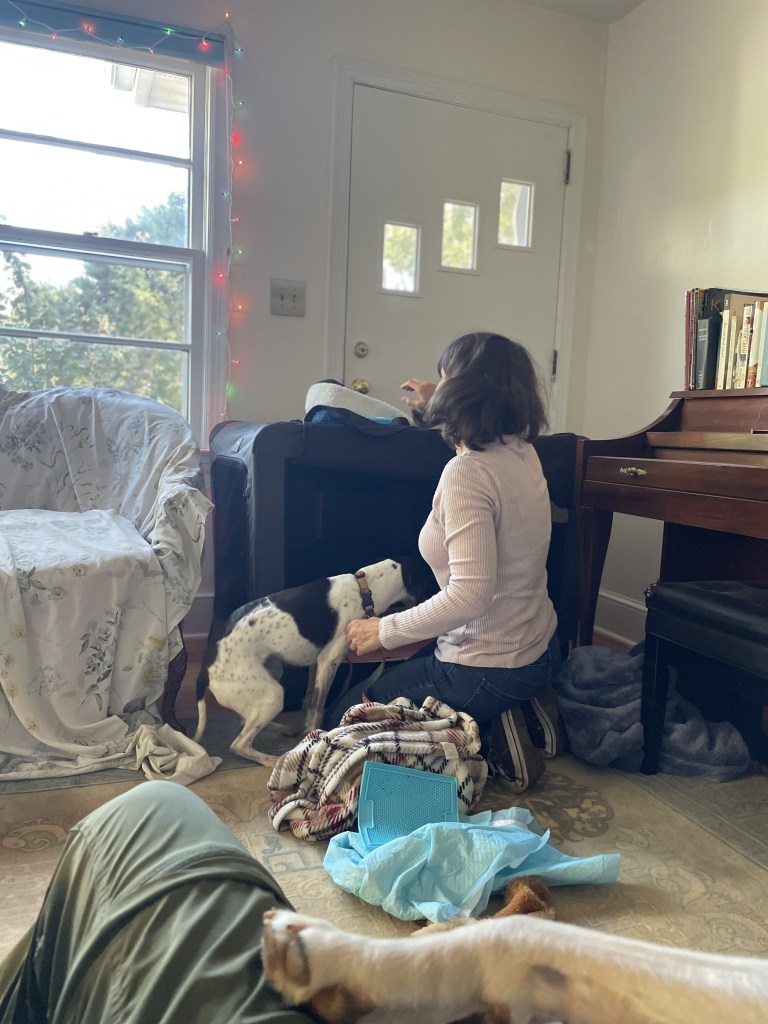
- Soft bedding and blankets. We have foam bed pads in Daphne’s crate, with a pee pad on top of them and a soft clean blanket on top of the pee pad. Despite our best efforts to get her outside every 2-2.5 hours around the clock, she has had several accidents in her crate. We have found that it’s best to have 3 sets of bedding: 1 can be in the crate, 1 in the wash, and 1 on standby in case it is needed before the 2nd set is out of the dryer. 1
- Pee pads. Pee pads absorb urine and keep it from soaking through to the bedding layers underneath. They can be bought at pet stores or ordered online. I bought disposable ones but you can get reusable machine-washable fabric ones.
- A sling. I ordered this one online when Daphne went into the hospital, knowing we would likely need it when she came out. It is a simple one with 2 adjustable handles (so you can make them a comfortable length for you) and a soft pad to go under her belly. It allows us to support her hind end and keep her from falling when we walk her. For bigger dogs or ones with more chronic hind end weakness, the Help ‘Em Up harness is excellent. (Not a paid endorsement! They really are wonderful.)
- Yoga mats, yoga mats, yoga mats. I cannot say enough about yoga mats. If you have wall-to-wall carpeting, you may not need them, but with any kind of a slick floor they are wonderful. They give your dog traction when they are trying to stand or walk. They are cheap. You can get multiple yoga mats and use them to cover the wood floor of your living room, or make a trail down the hallway for your dog. They are easy to pick up, move around, and clean. Do yourself (and your dog) a favor and get at least one!
- This is especially important if your dog is not able to move and turn over, and extra especially if they are also elderly and/or thin. Dogs in this condition are likely to develop decubital ulcers (bed sores) and believe me, it is easier to prevent bed sores than to treat them, and better for everyone involved. If your dog is not able to roll over, you should turn them from one side to the other every 4 hours and make sure their bedding is deep, soft, and clean. ↩︎
 climbing rose veterinary services