Daphne is doing well. Her gait looks almost normal now and she is no longer having urinary accidents. She is increasgingly energetic, restless, and bored. Ever since her surgery I have been doing a weight shifting exercise with her to help improve her balance and strengthen her hind limbs. She’s actually recently moved onto a more advanced version! I want to post a video of this basic one, though. This is a nice safe, gentle exercise that can help with the recovery from many different injuries and surgeries, including cranial cruciate rupture surgery and luxating patella surgery as well as back surgery.
Category: Uncategorized
-
Weight shifting exercise to improve balance and strengthen hind limbs -
Two steps forward, 1 step back; that’s the way it goes (if you’re lucky). Friday morning I saw that Daphne’s incision was suddenly red; she had obviously been licking it. (I am kind of impressed that she could reach it, I must admit.) I put her sweater, which is long enough to cover her incision, on her, and doubled her dose of trazodone.1 Ironically, she has seemed cheerier and more energetic since. I was working all day Saturday (attending a Continuing Education course) but my husband sent me a text that she seemed bouncy and happy. When I took her out this morning for her bathroom break, she wanted to wander all over the yard sniffing things. Her gait is fairly stable: mostly normal with some ataxia still. Tomorrow will be 2 weeks since her surgery and I will be able to add a few more rehab exercises. Unfortunately I will not be able to take her stitches out; her incision has been slow to heal, whether because of the licking, the prednisone, or both. Tomorrow her dose of prednisone will step down again.
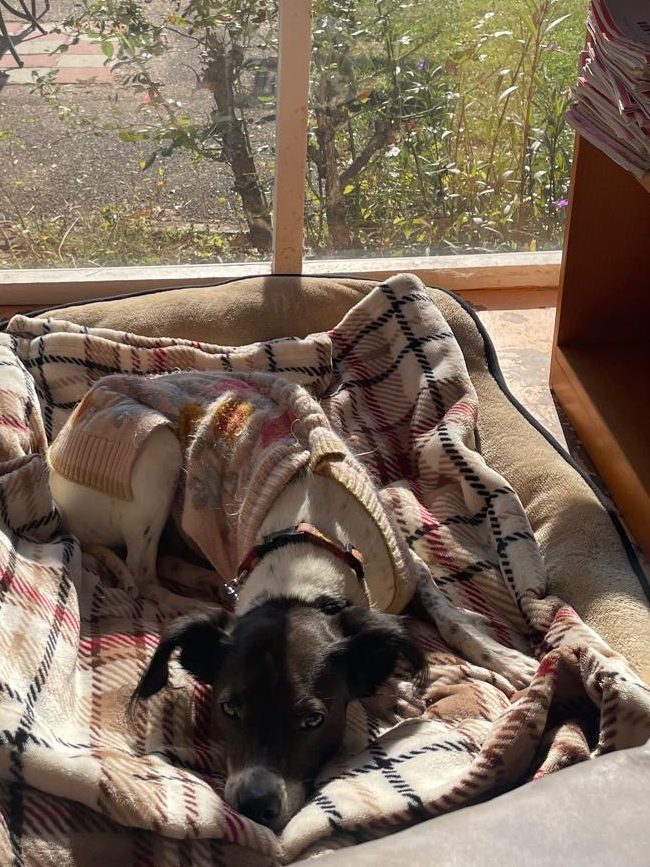
Hanging out with my husband (well supervised) on our screen porch - Trazodone is a sedative that UGA sent home to help keep her quiet and reconcile her to her crate rest. I have been giving her 1/2 tablet but when I saw what she was doing I went up to a whole tablet. ↩︎
-
Today has been another frustrating day. There have been a lot of pee accidents. Even as a vet, I am not sure why. She has some control; I can tell that because she urinates when we take her outside. Does she just have impaired control, so that when she gets excited (like when we come home) she pees? Does she have a UTI (but that seems less likely as I’ve had her on antibiotics for several days because she and our other dog were both intermittently licking her incision and I was worried it was getting infected)? Or are we leaving her too long (but we are only leaving her 2-3 hours max)? She doesn’t let us know when she needs to go. She never learned to do that, since she has had a dog door and 24/7 access to outside ever since we’ve had her. We need a better system to deal with this.
-
Daphne is doing well today. I am starting to notice a little mild muscle atrophy at her normally muscular thighs. This reminds me that, because her hind legs are weak, she is shifting a lot of her weight to her front legs. This, in turn, leads to muscle soreness around shoulders, neck, and chest. Most dogs with hind leg weakness love to have those areas massaged.
-
After improving dramatically during the first 72 hours postop, Daphne seems to have plateaued with mild ataxia. My vet brain knows that it has still only been 8 days since her surgery, that her spinal cord was pretty severely compressed, that neurologic healing is slow, and that she she could have a normal, comfortable, happy life even if she doesn’t improve anymore ever. My pet owner heart is sad that she is ataxic, that she may never get back to her normal/former state of athleticism, and that for the next several weeks we have to keep her separated from our other (young, crazy) dog Petunia. They obviously miss each other.
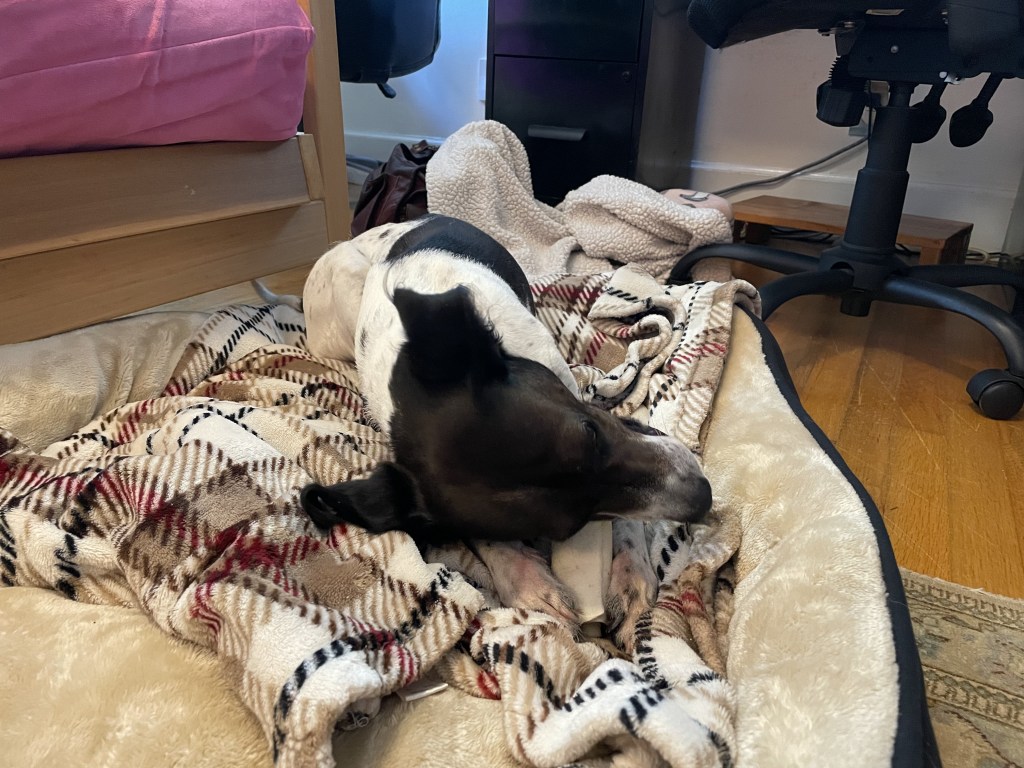
Some time out of the crate: she sits with me in this bed while I work at my computer. Our other dog is shut out of the room and Daphne’s access to all the furniture is blocked so she can’t jump up on anything and hurt herself. -

If your dog has an episode of IVDD, whether it’s treated medically or surgically, you’re going to need to crate them. They may have trouble using their hind limbs. They may be urinating excessively from steroids, be incontinent from IVDD, or you may be expressing their bladder. You’re also going to want to help them practice standing and walking at some point during their recovery. In any of these cases, there’s some equipment beyond the basic crate that is very helpful to have.
- Soft bedding and blankets. We have foam bed pads in Daphne’s crate, with a pee pad on top of them and a soft clean blanket on top of the pee pad. Despite our best efforts to get her outside every 2-2.5 hours around the clock, she has had several accidents in her crate. We have found that it’s best to have 3 sets of bedding: 1 can be in the crate, 1 in the wash, and 1 on standby in case it is needed before the 2nd set is out of the dryer. 1
- Pee pads. Pee pads absorb urine and keep it from soaking through to the bedding layers underneath. They can be bought at pet stores or ordered online. I bought disposable ones but you can get reusable machine-washable fabric ones.
- A sling. I ordered this one online when Daphne went into the hospital, knowing we would likely need it when she came out. It is a simple one with 2 adjustable handles (so you can make them a comfortable length for you) and a soft pad to go under her belly. It allows us to support her hind end and keep her from falling when we walk her. For bigger dogs or ones with more chronic hind end weakness, the Help ‘Em Up harness is excellent. (Not a paid endorsement! They really are wonderful.)
- Yoga mats, yoga mats, yoga mats. I cannot say enough about yoga mats. If you have wall-to-wall carpeting, you may not need them, but with any kind of a slick floor they are wonderful. They give your dog traction when they are trying to stand or walk. They are cheap. You can get multiple yoga mats and use them to cover the wood floor of your living room, or make a trail down the hallway for your dog. They are easy to pick up, move around, and clean. Do yourself (and your dog) a favor and get at least one!
- This is especially important if your dog is not able to move and turn over, and extra especially if they are also elderly and/or thin. Dogs in this condition are likely to develop decubital ulcers (bed sores) and believe me, it is easier to prevent bed sores than to treat them, and better for everyone involved. If your dog is not able to roll over, you should turn them from one side to the other every 4 hours and make sure their bedding is deep, soft, and clean. ↩︎
-
Daphne is doing well today. Her neurologic function is similar to what it was last night. Her gait improved over the course of yesterday; she seems to be swaying less as she walks. She is still mildly weak and ataxic, though, and we are still walking her with a sling to make sure she doesn’t fall.
Here is a tidbit from her exam this morning, and a brief explanation of proprioception. Proprioception is our ability to tell where our limbs are in space without looking at them. (If you close your eyes, you still know where your hands and feet are.) It is one of the first neurologic abilities to be lost with spinal cord compression. On her first day home, her proprioception was normal in her left hind paw but slow in her right. Yesterday it had improved to normal in both feet!
Checking proprioception. This shows that a signal is getting from her foot, through her spinal cord, to her brain and then back through her spinal cord to her foot. Her foot is telling her brain that it is turned over and her brain is telling her foot to flip back to a normal position.
-
Daphne is doing well today. My husband and I are tired. Daphne is on prednisone to decrease the inflammation in her spinal cord. Prednisone has several side effects; one of the more annoying ones is increased urine production.1 She may also have some decreased urinary control related to her spinal cord injury. Whatever the reason, she is desperate to urinate every 2-2.5 hours and if we don’t get her outside she will have an accident in her crate. My husband and I take turns getting up with her in the night and I am remembering what it was like to have a baby. Today I also rescheduled one of my client appointments so that I could run home and take her out. (This was unfortunate since I need to make money to pay for her surgery!) Even with this, she has had 3 accidents in her crate in the past 24 hours, so the washer and dryer are running constantly with her bedding. As a side note, this makes it hard to run the dishwasher, which cuts off if we try to run it at the same time as the washing machine or dryer. Still, her proprioception improved from yesterday and she seems to be feeing better, so today is an overall win. She even wants to play with our other dog (which, of course, we can’t allow)!
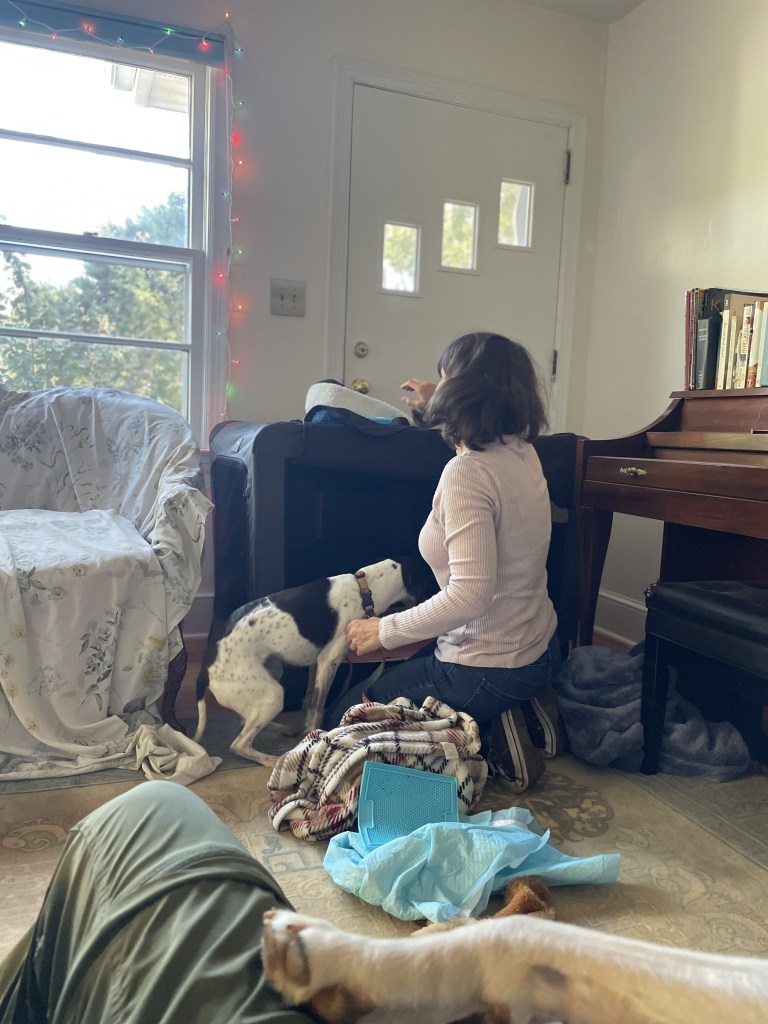
Here I practice the gentle art of holding onto her with one hand, so that she doesn’t try to jump on the couch or do anything else she shouldn’t, and changing her bedding with the other. I’ve had some practice at this over my years as a vet, but it is always a challenge. - A note about this: prednisone and other steroids cause the body to produce more urine. The patient then needs to drink more water in order to stay hydrated. Restricting water intake does not improve the situation; they will still produce more urine, but now they will also get dehydrated. ↩︎
-

Photo by: Alyssa Filkins (www.alyssafilkins.com) This is my own dog, Daphne. We adopted her in February 2020 from Athens Canine Rescue as a 5 month old puppy. She had been a stray and seemed to have missed some crucial socialization windows as a puppy. She was extremely timid, but over the years she slowly relaxed and learned to (mostly) trust us. She is amazingly athletic; she runs like a gazelle, leaps over obstacles in her path, and obviously delights in movement.
Last Tuesday she suddenly showed signs of back pain. She yelped when she jumped on or off of the couch and stood trembling with her back hunched and her head down. She had had a similar episode last spring which resolved with crate rest and medication, so I got the crate out and started her on meds. (Sometimes it is convenient to be a vet.) For 2 days she seemed painful, then for a day she seemed almost back to normal. Unfortunately on Friday she took a turn for the worse and acted very painful again. Saturday morning she began knuckling over on her hind feet, and being unsteady on her hind legs (which we call ataxia). These are signs that spinal injury is progressing from pain to actual neurologic impairment. By the evening she could barely move her hindlimbs and we took her to the UGA College of Veterinary Medicine teaching hospital on emergency. She was admitted and watched on Sunday. She continued to worsen, and on Monday she had an MRI which showed extensive degenerative disk disease and, at L4-L5, disk extrusion with spinal cord compression. She had decompressive surgery Monday afternoon, started rehab on Tuesday, and came home on Wednesday. Here she is on Thursday (aka Day 1):
About 72 hours postop -

Boo had to have her right front leg amputated last year. She now walks with a pronounced head bob and her neck gets tight and sore. She loves having it lasered!
Therapeutic lasers (also known as cold lasers or low level lasers) are a new and growing part of veterinary medicine. They are different from surgical lasers, which cut tissue and have been used in veterinary medicine for a while. Surgical lasers and therapeutic lasers are two different kinds of Class 4 lasers, meaning they are both powerful enough to cause burns and damage vision. Where surgical lasers cut, though, therapeutic lasers decrease pain, increase blood flow, and speed healing.
Photons of light emitted by the laser unit can penetrate tissues for up to a few centimeters. They are absorbed by cells and cause changes at a subcellular level. These changes can decrease pain signals, stimulate tissue growth and repair, increase stem cell proliferation, and have anti-inflammatory effects similar to nonsteroidal anti-inflammatory drugs (NSAIDs) and steroids. For instance, laser-delivered photons of light can increase the cellular production of nitric oxide, which in turn can relieve pain, decrease swelling, and stimulate faster wound healing by signaling more blood vessels to grow to the injured area. There is even some evidence that laser therapy can help with neuropathic pain, which is generally harder to treat than other types of pain.
I can now provide laser therapy in your home! It can be used for chronic inflammatory conditions such as arthritis as well as for wound healing (after a trauma like a snakebite, fight wound, abscess, or road rash), surgical incisions, tooth extraction sites, infected ears, inflamed bladders, etc. It can’t be used on eyes, as the laser beam can damage vision, and the vet, owner, and pet should all wear safety goggles while the therapy is being administered. (If you haven’t seen your dog wearing Doggles, as the canine goggles are called, you are missing out!) Burns don’t occur unless the laser is held in one spot for an extended period of time, and I am trained not to do that. We usually don’t treat tumors with laser therapy as it theoretically can speed tumor growth. However, if the animal is in a hospice situation where we are no longer trying to cure the cancer but only keep the animal comfortable, laser therapy could be part of the pain control plan as long as the owners understand it could speed up the tumor’s growth.
One of the most attractive things about laser therapy is that it typically feels good to the animal. It usually takes 2-5 minutes to treat a given area (tight neck muscles, for example, or an arthritic hip, or a skin wound). During that time many animals go from tense to relaxed; some even fall asleep. Conditions on the surface (like skin wounds) may need just 1 or 2 treatments, where deeper and more chronic conditions (like arthritis) may need 2-3 treatments a week for several weeks before they provide a full benefit. At that point they can usually be tapered off to a more manageable maintenance schedule. I have observed, though, that some patients seem to feel better after just a single treatment.
Cleo having her knee lasered after surgery. I say that “The Doggles are the best part,” but really the pain relief and accelerated healing are the best part!
 climbing rose veterinary services